

Share this Post
A Retirement Account at Birth? Understanding the New Trump Account
When Congress creates an entirely new type of savings account, financial planners pay attention. And yes, it's officially called a Trump Account. (I didn't name it. You didn't name it. But here we are.)
Politics aside, this new account creates a potentially significant planning opportunity for families. For the first time, children can begin accumulating tax-deferred retirement assets from birth, potentially allowing decades of compounding before they ever earn their first paycheck.
If you have a child, grandchild, niece, nephew, or know someone welcoming a baby in the next few years, this article will walk you through:
- What Trump Accounts are
- Who qualifies
- How to receive the government's $1,000 pilot contribution
- How they compare to 529 plans, Roth IRAs, and custodial accounts
- Planning opportunities for our clients
- What questions still remain unanswered
What Is a Trump Account?
A Trump Account is a new type of tax-advantaged retirement savings account established under Internal Revenue Code Section 530A. Think of it as a specialized IRA designed specifically for minors.
The account is established exclusively for the benefit of an eligible child and follows a unique set of rules until the child reaches age 18 (more specifically, Dec. 31st of the year the child turns 17). After that, the account begins to function almost identically to a traditional IRA.
Why This Matters
Trump Accounts are notable because they are:
- The first retirement-oriented account that can begin at birth
- Tax-deferred*
- Eligible for contributions from multiple sources
- Designed to potentially compound for decades before workforce entry
Even a relatively modest balance can become meaningful when given 50+ years to grow. This headstart on compound interest is not something to be ignored.
*Much like a Roth IRA contribution, the original contribution forms a basis that can be withdrawn tax-free in retirement. The growth on contributions is the part that grows tax deferred. A little complicated, I know. It wouldn’t be a US Retirement Account if we didn’t make it confusing, am I right? More on this later.
Two Different Sets of Rules
One of the more confusing aspects is that two separate legal frameworks apply to these accounts.
The Trump Account Rules: The account itself is governed by Internal Revenue Code Section 530A, which was created by the One Big Beautiful Bill Act. These rules establish the core structure of the account and govern:
- Account establishment
- Contributions
- Investments
- Distributions
- Which children qualify for the $1,000 contribution
- How and when an election must be made
- Treasury's procedures for processing contributions
- Timing requirements
- Verification and administrative requirements
The fact that a child can open a Trump Account does not automatically mean they qualify for the $1,000 pilot contribution.
Who Is Eligible?
To establish a Trump Account, a child generally must:
- Be under age 18
- Have a valid Social Security Number
- Be a living child (accounts cannot be established before birth)
The account beneficiary is always the child. An authorized individual (typically a parent or guardian) must establish and manage the account during childhood. There is also a hierarchy of who this authorized individual can be. If you are a grandparent wanting to set this up for your grandchild, I’d take a moment to pause. The parent/guardian gets first dibs to create the account, and there can only be ONE Trump account per eligible child.
Who Qualifies for the $1,000 Government Contribution?
To receive the pilot contribution:
- Child must be born between January 1, 2025 and December 31, 2028
- Child must be a U.S. citizen
- Child must have a valid Social Security Number
- An election must be properly filed
The Deadline Many Families Will Miss
A Trump Account generally needs to be established before January 1 of the year the child turns 18. Once that date passes, a new Trump Account cannot be established, although existing assets may still be eligible for rollover treatment under applicable rules.
For practical purposes:
- If a child is already turning 18 this calendar year, it is too late to establish a new account.
- Families should act sooner rather than later.
How to Open a Trump Account
Current guidance (which is a bit lackluster and highly confusing) indicates the following process:
Step 1: Confirm Eligibility
Verify:
- Child's date of birth is within eligibility window
- They have a valid U.S. Social Security Number
- U.S Citizenship status
- If seeking the government-funded pilot contribution, was born between January 1, 2025 and December 31, 2028
Step 2: Open the Account
The authorized individual (typically a parent or legal guardian) will need to establish a Trump Account for the child through an approved provider.
Current guidance indicates:
- The U.S. Treasury has designated The Bank of New York Mellon (BNY) as the program's financial agent.
- Robinhood has been selected as the initial trustee and account platform for Trump Accounts.
Based on current information, families should expect to open the account directly through the approved platform, similar to opening a custodial investment account. However, Treasury has not yet released final operational procedures confirming exactly how account onboarding will occur.
Step 3: Complete the Election
Opening a Trump Account alone may not be sufficient to receive the government's $1,000 pilot contribution.
Current guidance references:
- Form 4547, and/or
- A future Treasury online election portal
The purpose of this election is to notify Treasury that an eligible child has a qualifying Trump Account and is requesting consideration for the pilot contribution.
Step 4: Link and Verify the Child
The authorized individual will need to provide information necessary to verify the child's identity and eligibility. Only one Trump Account may be maintained for an eligible beneficiary at any given time.
Step 5: Receive the Pilot Deposit
Once Treasury processes the election, the $1,000 contribution is deposited into the account.
Important Timeline
January 1, 2025: Pilot eligibility period begins
July 4-5, 2026: Contributions expected to begin
2025-2028: Eligible birth years for $1,000 contribution
Age 18: Growth period ends
Current regulations remain proposed rather than final, meaning operational details may still change.
The Two Phases of a Trump Account
Phase 1: Growth Period
Birth through December 31 of the year the child turns 17. Restrictions include:
- No distributions (except limited exceptions)
- Limited investment options. Refer to investment section of this article for details.
- No aggregation with traditional IRAs
- Contributions are not deductible, unless made by an employer
- Contributions create basis
Phase 2: Post-Growth Period
Begins after child turns age 18. New options become available:
- Traditional IRA rules generally apply
- Roth conversions permitted (this is the biggie)
- Transfers to other IRAs permitted
- Rollovers to eligible retirement plans permitted
- Broader investment choices become available
This transition period may create significant planning opportunities.
Contribution Rules
Contributions generally cannot begin before July 2026. There are five contribution categories:
1. Pilot ContributionGovernment-funded $1,000 deposit.
2. Family ContributionsParents, grandparents, relatives, and friends may contribute. Current limit:
- $5,000 annually**
- Indexed beginning in 2028
Unlike a Roth IRA: No earned income is required (another biggie).
3. Employer Contributions
Employers may contribute up to:
- $2,500 annually
- Excluded from employee income
- Deductible to employer
- Counts toward annual limits (important to remember)
4. Qualified General Contributions
Governmental entities and nonprofits may contribute through Treasury-administered procedures.
5. Qualified Rollovers
Certain trustee-to-trustee transfers are permitted under specific rules.
**As of today, contributions do not count toward the annual gift tax exclusion. As a result, IRS Form 709 (Gift Tax Return) must be filed for any contribution made, regardless of the amount. The contribution will reduce the donor's $15 million lifetime estate tax exemption, but generally will not result in any gift tax being owed.
Investment Restrictions
During the growth period, investments are intentionally narrow.
Allowed:
- Broad-based index mutual funds
- Broad-based index ETFs
- S&P 500 tracking funds
- Similar U.S. stock index funds
Must generally:
- Track broad U.S. equity indexes
- Have expenses below 0.10%
- •Avoid active management
Investments that are NOT permitted include sector funds, ESG-specific funds, leveraged funds, inverse funds, and cash holdings beyond temporary needs. Let me repeat that last part again incase you missed it, no cash holding beyond temporary needs. I love this. All contributions are required to be invested, which is exactly how I believe it should be for a child with a very long time horizon. Compound growth!!!
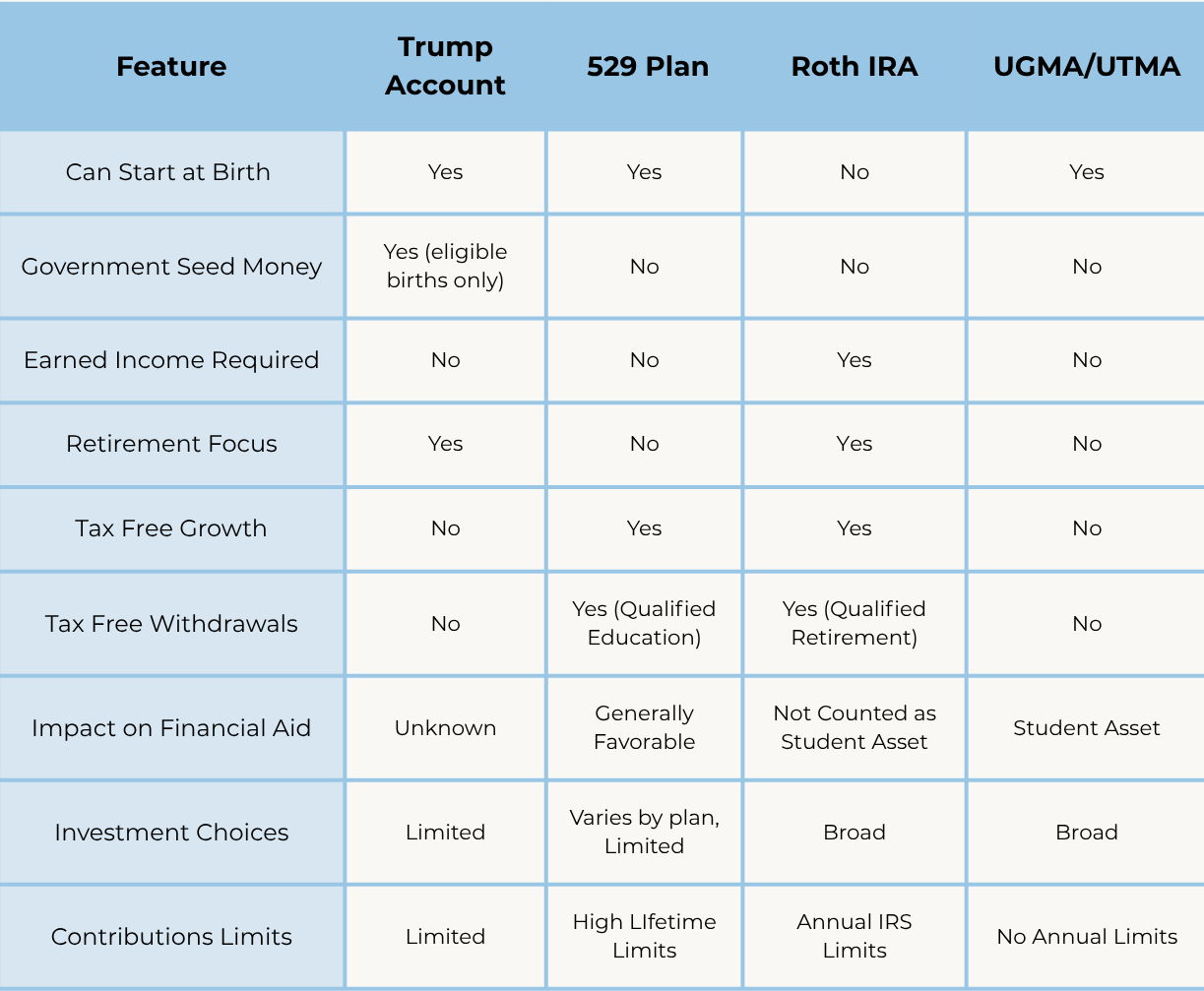
How Trump Accounts Compare to 529 Plans, Roth IRAs, and Custodial Accounts
Where We See Planning Opportunities
Trump Accounts shouldn’t and wouldn’t be able to replace 529 plans, custodial accounts, or Roth IRAs, but they do provide a nice complement to the planning strategies we can implement for children.
Potential Use Cases – How BFA will be incorporating these accounts to client planning
- Children without earned income. A Roth IRA isn't available yet, but a Trump Account may be.
- Grandparent gifting strategies. Annual contributions can help build retirement assets decades before workforce entry.
- Future Roth Conversion Planning. Once growth-period restrictions end, strategic Roth conversions may become attractive. This is the planning opportunity that made my ears perk up. At 18, your child’s tax bracket is usually low. A roth conversion at this time could give them a massive boost in after-tax retirement assets that are poised to grow tax-free for the rest of their lives.
What We Still Don't Know
Several important questions remain unresolved. Areas awaiting additional guidance include:
- Excess contribution correction procedures
- Post-growth-period administration
- Coordination among multiple contributors
- Operational implementation details
- Reporting requirements
- State tax implications on Trump account earnings
Financial professionals should expect additional Treasury and IRS guidance over time. It is a personal priority of mine to track these outstanding bits of information so our clients don’t have to.
The Bottom Line
If you know a child born between 2025 and 2028, don't ignore this opportunity. At a minimum, eligible families should strongly consider:
- Confirming eligibility
- Filing the required election
- Opening the account
- Receiving the $1,000 government contribution
- Evaluating with your financial advisor whether additional family contributions make sense
The long-term use case for these accounts remains unclear.
Will Trump Accounts replace 529 plans? Definitely not.
Will they replace Roth IRAs? Absolutely not.
But they create a brand-new planning tool that didn't previously exist: a retirement account that can begin at birth, receive government seed money, and potentially compound for decades before its owner ever receives a paycheck. That's worth paying attention to.